
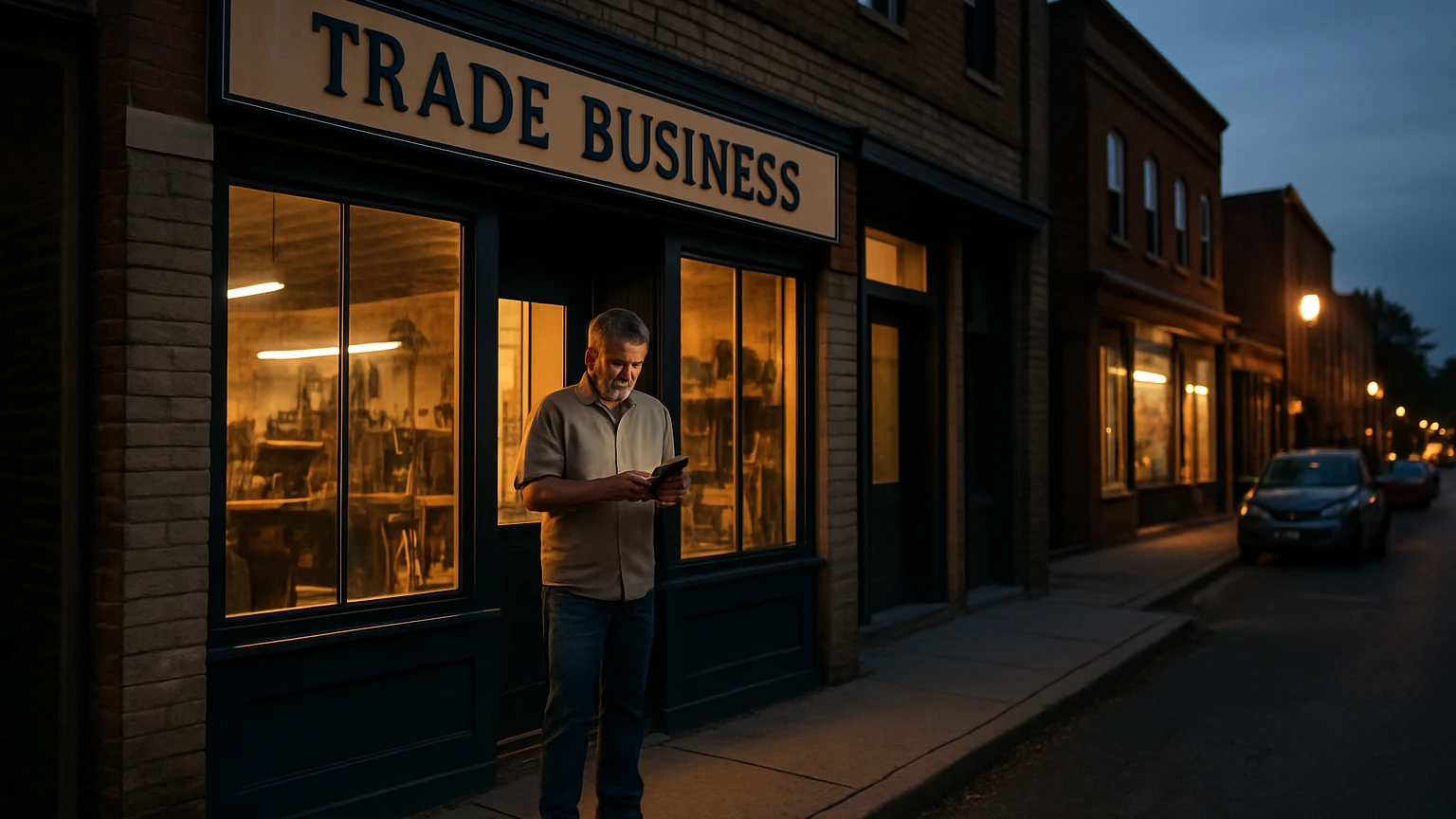
You've built a solid business in Edwardsville or the broader Metro East. Word of mouth keeps the phone ringing. You've got a Google Business Profile, maybe a Facebook page. The question keeps coming up at chamber meetings and coffee shops on Main Street: do you need a website, or is that one more expense for something that sounds like marketing noise?
Yes, your small business needs a website
Eighty-one percent of consumers research a business online before making a purchase. Your website is where that research happens. Without one, you lose the customer before they ever pick up the phone.
It doesn't matter how good your craft is. When a potential customer Googles your business name and finds nothing, doubt creeps in. Many customers assume a business without a website is outdated, unreliable, or untrustworthy. You're not even in the running if you don't show up where they're looking. Even a small site covering the essentials every local business site needs puts you back in the conversation.
You're losing referrals you'll never know about
Word of mouth still works, but only if the referral makes it all the way to the phone call. A local business without a website loses an estimated 20 to 35 percent of referred customers during the verification step, the moment between hearing about a business and deciding to contact them.
Here's what that looks like in practice. A friend tells your name to someone who needs your service. That person opens Google on their phone while sitting at a stoplight. They type your business name. No website comes up, only a Google Maps pin with a phone number. Maybe some reviews. They keep scrolling. They find a competitor with a clean site, clear services, and photos of past work. They call that number instead.
You never knew they searched. You never knew the referral happened. Customer A tells Customer B to use Mike's Plumbing. Customer B searches for Mike's Plumbing, finds no website, Googles "plumbers near me," calls the first result with a website. Mike never knows it happened, never gets the call, never sees the lost revenue, and continues believing word of mouth is working great while his competitor picks up his referrals.
Social media is not enough
A Facebook page is not a website. Instagram is not a website. Social media platforms own your audience. If Instagram changes its algorithm tomorrow, or your account gets reported and suspended, you lose access to everyone who followed you overnight with no warning.
A website is the only online space your business owns. No algorithm decides who sees your content. No platform can delete your account. You control the message, the layout, and the customer experience from the first click to the contact form submission.
Google doesn't rank your Facebook page the same way it ranks a real website. With the continuing advancement of mobile search and the increasing popularity of voice search, local search visibility is important for every local business. If you don't have your own website, your local SEO services agency will find it almost impossible to give you the level of visibility needed to drive footfall to your local business. You're invisible to the people typing "roofer near Edwardsville" or "HVAC repair Collinsville IL" into Google. Those are the searches an Edwardsville web design build is meant to win.
What a website does while you sleep
Unlike a physical store, your website never closes. It can answer customer questions anytime, take bookings or orders even when you're asleep, provide directions to your business. This means customers can engage with your business whenever it's convenient for them, increasing your chances of making a sale.
The roofer up the road with a website is capturing leads at 10 p.m. On a Sunday when someone realizes their ceiling is leaking. You're asleep. The lead goes to the competitor, not because their work is better, but because they were findable when it mattered.
A website is a 24-hour storefront, a portfolio, a credential, and a lead capture machine rolled into one asset. It's not marketing fluff. It's infrastructure.
The cost of not having a site is higher than the cost of building one
For most service-based and local businesses, realistic project budgets for a professional build fall between $4,000 and $15,000. DIY builders look cheaper on paper, and the tradeoffs between a builder and a custom site are worth knowing before you commit. That range feels like a lot if you're focused on the invoice. But look at the other side of the ledger.
Every month without a website, you lose 10 to 15 customers who searched on Google, found your competitor, and booked with them instead. What's more expensive: the cost of a website, or losing 120 to 180 customers per year to competitors who invested in SEO?
For a trade business doing $500 per job, three lost referrals times $500 equals $1,500 per month in invisible revenue loss. That's $18,000 per year lost to referral leakage alone. A $7,997 flat build pays for itself in under four months at those numbers.
The website isn't an expense. It's the thing that stops the revenue leak you didn't know you had.
Customers expect to see proof before they call
Having a website gives your small business legitimacy. When someone is searching for your product or service online, you want to appear in those search results. Additionally, having your own domain name gives your email address additional legitimacy. If you're sending an email from a personal email address, potential customers may not take you as seriously.
Your website is where trust gets built. It's where potential customers see your past projects, read testimonials from people like them, and get a feel for how you work before they ever call. Displaying your best reviews or testimonials prominently on your website is a great way to establish social proof. Publishing your best reviews on your website also serves the secondary purpose of creating a permanent archive.
Google Business Profile reviews help, but a website lets you control the narrative. You're not stuck hoping someone leaves a five-star review on the right day. You're showing them exactly what they need to see to make the decision.
What to do next if you don't have a site yet
As of 2026, approximately 27 percent of small businesses in the United States still don't have a website. You're not alone if you've been putting this off. But every month you wait is another month of customers going to someone else.
If you're a serious local business in the Metro East, competing with operators who do have sites, you can't afford to stay invisible. The family-owned HVAC company in Glen Carbon, the electrician in Maryville, the roofer in Collinsville who's losing jobs to a competitor with a slick site and half the experience. This is the gap a website closes.
LocalCraft Digital builds marketing websites for local businesses in Edwardsville and the Metro East that look as good online as you do in person. The sites go live in 48 hours, not three months. No discovery calls, no revision cycles, no agency overhead. See how it works and what a fast, conversion-focused build looks like for a business like yours.
Ready to stop losing customers to competitors with better sites?
Every week you wait is another week of leads landing in someone else's inbox. If your business is serious about staying competitive in the Metro East, your website is the infrastructure that makes everything else work. Start a build and get your site live this week.