
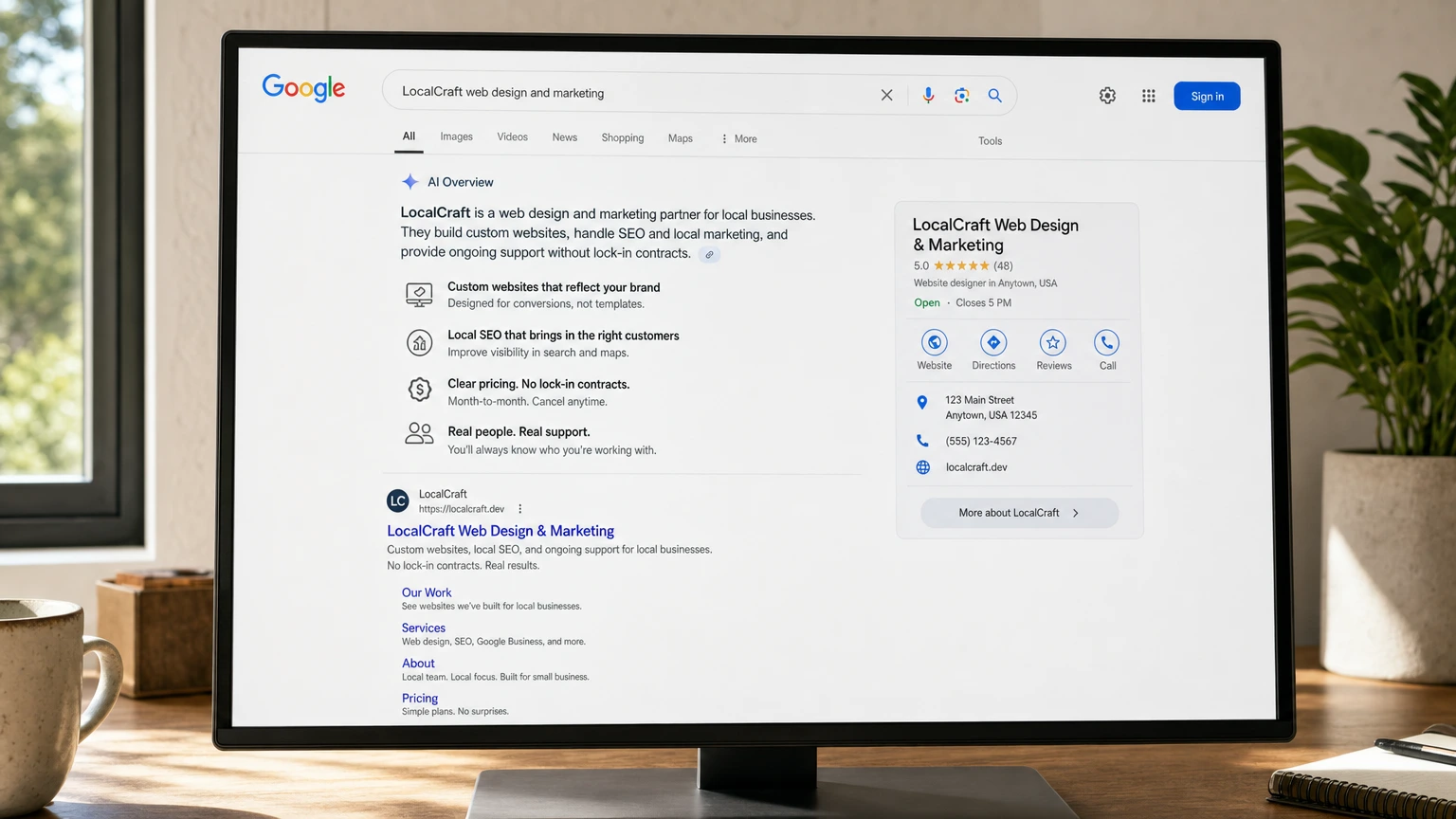
Owners in Edwardsville and Glen Carbon keep asking me the same question in different words. Is the AI answer box at the top of Google going to take my customers away? Fair thing to worry about. The box is large, it sits above everything else, and the coverage around it runs hot enough to keep a person up at night.
On July 30 I stopped guessing and pulled data. Search volume for twenty-two terms at the national level, the same terms sized down to the St. Louis metro, and three live searches run from Edwardsville for the kind of work a service business gets paid to do. What came back was calmer than the headlines.
What an AI Overview is
An AI Overview is a block of generated text Google places above the regular results, assembled from sentences across several pages and credited to a few of them with links off to the side.
The block reads like a short article instead of a list of blue links. A searcher who wanted a definition often gets what they came for and never clicks through, which is exactly where the traffic worry comes from.
Two things separate an AI Overview from the older featured snippet. A featured snippet lifted one passage from one page, so one site clearly won it. An AI Overview writes new sentences drawn from many pages, so no single site owns it, and the citations sit in a panel most people never open.
When Google shows one, and when it holds back
Google shows an AI Overview when the query looks informational, meaning the searcher wants an explanation. Queries that point at a business in a specific town behave differently.
How to fix a running toilet is an explanation request. Plumber in Edwardsville is a hiring request. The first can be satisfied by a paragraph. The second ends with a phone call, a truck in a driveway, and an invoice, and no paragraph of generated text can deliver those.
That split is the whole story. Better yet, it is measurable, so nobody has to argue about it.
Worth noting too: the same searcher moves between both modes in one afternoon. A homeowner reads three explanation pages about why a water heater leaks, decides the repair is beyond them, and then searches for someone in town. The reading part may end in a summary. The hiring part ends on a map. Your site can be present in both places, and the two jobs call for different pages.
What three Edwardsville searches returned on July 30
Three service searches run from Edwardsville on July 30, 2026 returned no AI Overview at all, and a three result map pack every single time.
- plumber edwardsville il: no AI Overview, map pack present, 10 of 10 organic results were town specific URLs.
- ac repair near me: no AI Overview, map pack present, 8 of 10 organic results town specific. Google rewrote near me into Edwardsville before it ran the search.
- water heater replacement edwardsville il: no AI Overview, map pack present, 10 of 10 organic results town specific.
The map pack on the middle search filled with two Edwardsville HVAC companies and one large St. Louis operation, every one of them rated above 4.5 by its customers. Three businesses, top of the page, sitting where the summary was supposed to be.
Why local service intent holds up
Local service intent resolves to a place, a phone number, and a person who can show up, and a generated paragraph cannot supply any of the three.
Google already built a product for that exact job, and it is the map pack. Position there depends on proximity to the searcher, on a complete Business Profile, and on review count and recency. None of those inputs changed when the summaries arrived.
The organic results underneath tell the second half of the story. On two of the three searches, every result on page one was a town specific page, meaning a service page or a location page with Edwardsville in the URL. Google is rewarding pages built for one town and one job. A site with a single services page covering eleven towns and nine trades is competing against pages that are sharper than it is, and sharpness wins. More on how to pick which pages to build is in sizing real search demand before you write a page.
Where the summaries do live
Informational and definitional queries are where generated summaries appear, and the demand behind them is national rather than local.
The term ai overviews draws 110,000 searches a month in the United States. In the St. Louis metro it draws 880. Local seo draws 12,100 nationally and 40 here. Is seo dead draws 720 nationally and 10 here.
That gap matters more than the raw numbers. Definitional traffic is enormous in aggregate and thin in your county. A summary absorbing some of that traffic is absorbing readers who were never close to hiring a plumber in Maryville.
The data holds one more tell. Several phrases people repeat at conferences return no volume at all, even nationally: generative engine optimization, how to rank in ai overviews, how to show up in chatgpt search. No volume means Google has no measurable demand on record for that phrase. Worth checking against a live results page before you dismiss it, and not worth building a content calendar around.
What to write now
Service pages carry local revenue, so build one page for each job you want to be hired for, in each town you serve.
Name the town in the title, the URL, and the first paragraph. Put the phone number where a thumb lands on a phone. Describe the work in the words a customer uses instead of the words the trade uses. Water heater replacement beats hydronic system service when your reader is standing in a wet basement at 6am.
Then write informational content against a different scoreboard. A post that answers a real question well can be pulled into a summary, and being pulled in puts your business name in front of a reader at the moment they are learning. Publish fewer posts, answer questions customers ask on the phone, and put the answer in the first two sentences under each heading so a machine reading that section alone still gets the full answer. Skimming humans benefit from the same structure.
Two structural habits help a page get quoted accurately. Give every section a heading that reads like a question a customer would ask, and answer it in the sentence right below the heading, in full, without leaning on the paragraph above. A machine reading one section in isolation gets a complete answer, and the reader on a phone gets one too.
If your work lives on phone calls and the site needs rebuilding, LocalCraft’s website plans show how the build and ongoing work fit together.
Two checks worth ten minutes
Two checks will tell you how exposed your own site is to generated summaries, and each one takes about five minutes.
First, open a private browser window and run the three searches you most want to be hired from, with your town in the query. Note whether a summary appears, whether the map pack appears, and whether your listing is inside it. Those three results are your real situation. National averages do not decide who Google shows in Edwardsville.
Second, list the pages on your site that define a term or explain a concept. Those are the pages most likely to lose clicks to a summary. If any of them bring you leads, add the specific detail a generated paragraph cannot copy: your prices, your photos, your town, the thing you learned on a job last spring. A wider view of that shift is in whether SEO still matters in AI search.
Where to start
Run the one search you most want to win, from your own town, and write down what fills the first screen.
Most owners find the map pack sitting exactly where they feared a summary would be, then find their own listing in fourth place, one slot below the fold. That is a Business Profile problem and a service page problem. Both are fixable, and neither is the emergency the headlines describe.
If you want a measured second set of eyes on the page, start with the free AI IQ check. It records the crawler, identity, answer and evidence signals it can verify, and keeps missing measurements separate from failures.